Garage Doors
A little know-how
Garage door trouble tends to announce itself: a new sound, a slower climb, a gap under the seal. These articles help you read those signals and decide what to do next.
Frequently asked questions
Why does my door reverse on the way down for no reason?
Most often it is the photo eyes. A sensor knocked slightly out of line, a lens with a film of road grime, a loose wire, or low afternoon sun shining straight into one eye will each break the beam as far as the opener is concerned. The next candidates are a down-force setting that has drifted, a binding roller or a door that has gone out of balance. The inspection checks each in turn.
How often should a garage door be tuned up?
Once a year suits most attached garages here, ideally in the fall before cold weather thickens lubricant and stiffens seals. Door and opener makers suggest lubrication every three to six months and a homeowner balance check and reversal test every month, so an annual professional visit sits on top of that light routine. A lightly used door in a detached garage may go longer; a heavily used one, or one exposed to salt spray, benefits from a spring check too.
Will the door be as good as it was before?
In most cases it comes back better, because the reset includes truing the track, replacing worn rollers and correcting the misalignments that had been building unnoticed. The exception is a section creased by an impact: it may work perfectly well after the reset yet keep a visible dent, and the technician will tell you whether it is sound or worth replacing at some point. You are shown the door running before the visit ends.
What happens if my door's design has been discontinued?
It happens with older doors, since embossing patterns, joint profiles and colours change over the years. The technician looks for the nearest current section from the same manufacturer and describes how it would differ in look and fit. Sometimes the difference is minor and acceptable; sometimes the joint no longer mates. In that case the options are a section from a compatible series, or replacing the door as a whole, and both are explained before anything is ordered.
How do I look after the new seal?
Wipe it clean of salt and grit a few times a year, and give it a light coat of silicone spray each autumn so meltwater has nothing to bond to. Keep petroleum products and solvents away from it, since they soften vinyl. Clear ice and packed snow from the threshold before running the door in winter. Once a season, look under the closed door for daylight. That is the whole routine.
Can the seal be replaced in winter?
Yes. The technician keeps the lengths warm in the van until the moment they are fitted, because cold vinyl is stiff and can split at a fastener, and works with the door closed so the garage is not open to the weather for long. Jamb repairs can be done in the cold as well. Many households have it done in autumn or winter because that is when the gaps make themselves felt.
What lubricant belongs on a garage door lock?
Dry graphite or a PTFE lock lubricant for the key cylinder, because oil traps grit and moisture in the pins. A light silicone film for the bars and their guides, wiped rather than dripping, so salt spray and slush have less to cling to. Grease is avoided everywhere on the lock, as it thickens in the cold and collects dirt that gums the action.
What is the difference between two-inch and three-inch rollers?
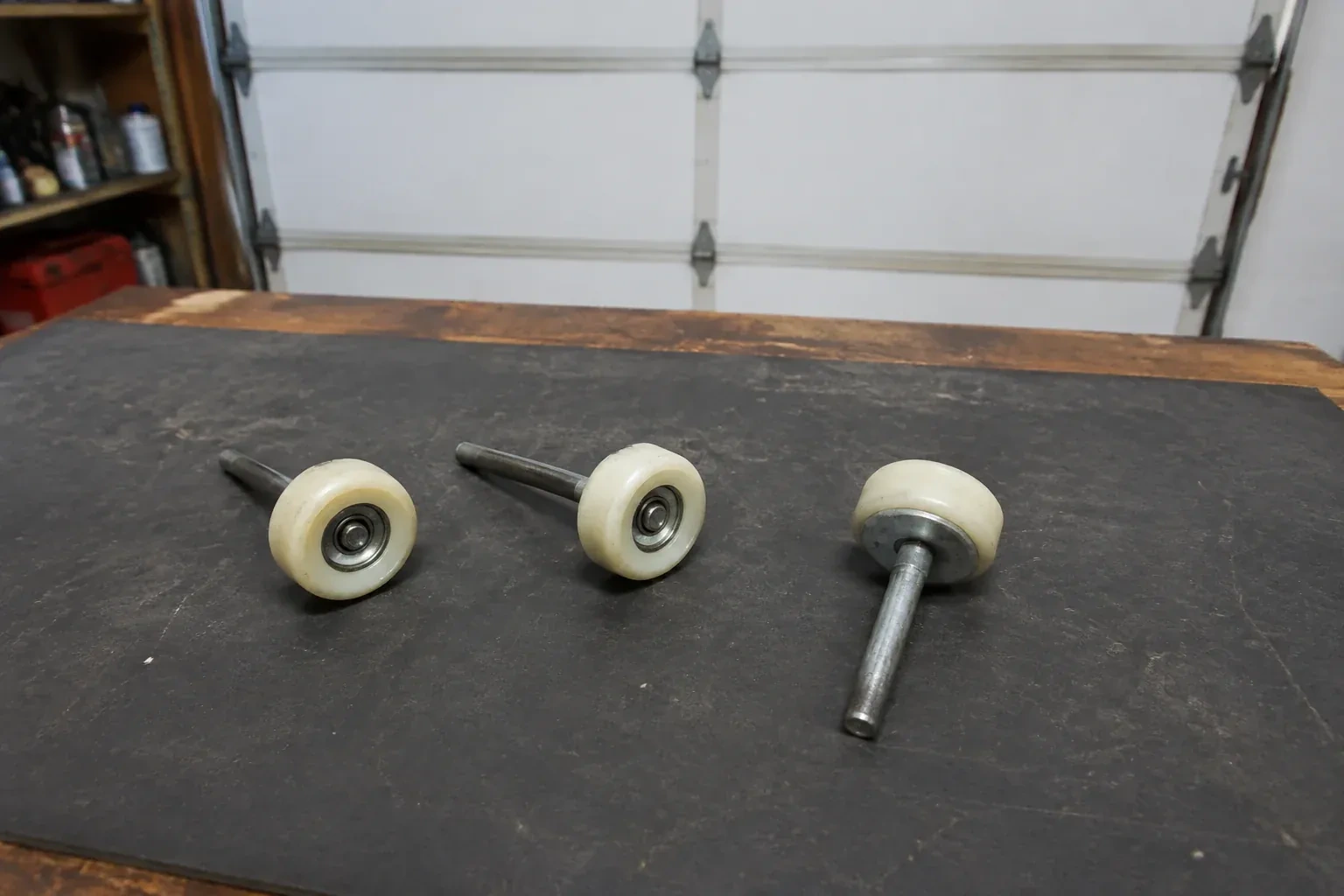
The figure is the wheel diameter, and it has to match the track. Residential sectional doors run on two-inch track and take a two-inch wheel; commercial doors can run on either two-inch or three-inch track, so the wheel is matched to what is actually installed. Wheel size has little to do with noise, which comes from the wheel material and bearings. The technician measures the track and the existing wheel before ordering so the set fits, since a mismatched wheel either jams in the channel or rattles around in it.
Why is there a gap opening between two panels as the door goes up?
The two panels at that joint are no longer being held together on one side. A hinge that has cracked through, pulled its screws or lost its pin lets the panels hinge open around the remaining hardware, and the gap shows as they round the curve where the joint flexes most. Replacing the failed hinge, and checking its partner on the other end, brings the panels back into line.
Why is the horizontal track sagging?
The horizontal run hangs from the ceiling on back hangs of perforated angle, and it sags when a hanger bends, its screws pull out of a joist, or it was only ever fixed into drywall. A sagging hanger droops that run out of level or its intended pitch. The fix is a straight or new hanger screwed into solid framing, with the run set to the manufacturer's specified pitch and matched to its partner; a door that drifts back toward the opening once raised is a separate, balance-related symptom.
What information helps when I call?
Whether the door is sitting crooked, jammed partway or on the floor; whether you can see a cable hanging loose, frayed or wrapped around the shaft; whether there is a spring above the door or springs along the tracks; the door's rough height and whether it is a single or double; and what happened just before, such as the door coming down on something. A photo of the drum end and the bottom corner is useful.
What does a cycle rating mean?
One cycle is a full open and close. Springs are built for a set number of cycles, and a standard residential spring is commonly rated around ten thousand. A household that uses the door six times a day reaches that in roughly four to five years, while a door used twice a day stretches the same rating much further. Higher-cycle springs use heavier wire and a longer coil to produce the same force with less stress, so they last proportionally longer.
What can I do to make the new springs last?
Three things. Spray the springs, pulley axles and hinges with a garage-door lubricant twice a year, which slows rust in an unheated garage. Keep the threshold clear of bins and packed snow so the door never stops short with the springs still pulling. And leave the opener's force setting where the technician put it, since a door that starts needing more push is a balance question rather than a dial to turn.
The door was fine until a power cut. Why is it heavy now?
During a power cut the door is often released and moved by hand for the first time in years, and what people discover is a door that had already grown heavy while the opener quietly covered for it. The outage did not change the springs; it revealed them. A balance check confirms what the door weighs against what the springs give, and resets them to match.
Is a smart, app-connected opener diagnosed any differently?
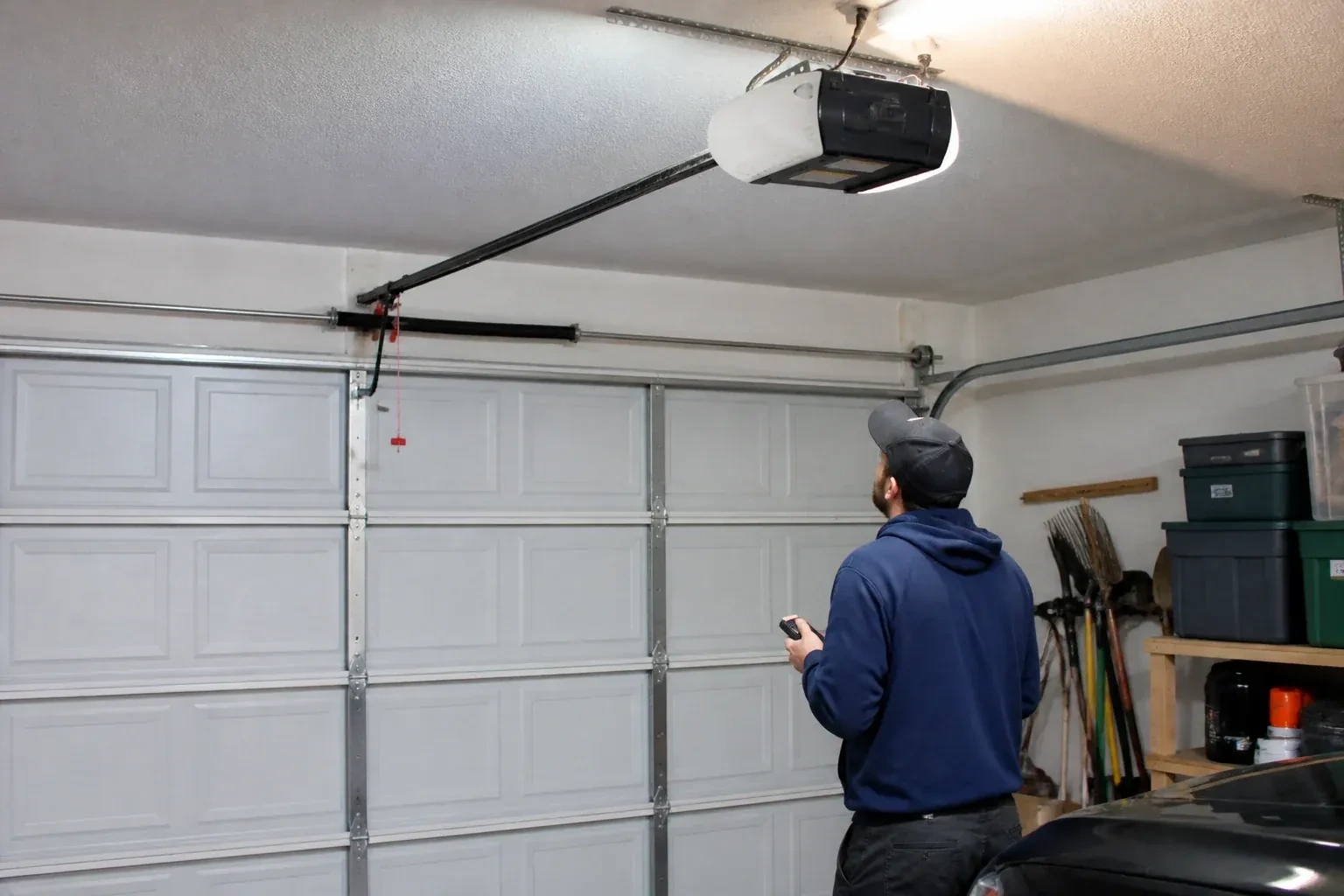
The mechanical and electrical checks are identical, since the app is just another control. What is added is the connection: whether the head unit is on the home network, whether the app reports a fault code you can read off your phone, and whether a door-position sensor or hub has lost its pairing. Because the wall control and remotes work independently of the network, a door that fails on every control is a hardware question, not a connection one.
How much slack should the chain have?
It is a measurement, taken with the door closed and disconnected from the trolley. At the middle of the rail the chain should sit at the height the opener's own manual specifies for its rail shape, since the figure is not the same across makes. The two nuts on the trolley set and lock it. With the door reconnected and closed, some droop appears; that is expected as long as the measurement returns when the door is open.
How long does a belt-drive repair take?
A tension adjustment with the safety tests is a short visit. Replacing the belt, trolley or idler pulley, then phasing the motor, relearning limits and running the reversal tests, is usually an hour or two. A gear-and-sprocket kit at the motor head takes longer because the head unit is opened. If the balance test turns up spring work, that is agreed as a separate job with its own time.
Will a new opener make the door quieter?
A belt or direct drive with a soft-start DC motor removes most of the operator's own noise, and a level, well-tensioned rail removes the rattle. The door contributes its own sound through rollers, hinges and springs, so the technician looks those over during the balance check and can fit nylon rollers or fresh hinges at the same time. Together the two changes turn a morning rumble into a hum.
What can I check myself before calling?
Three things, all safe. Look along the floor between the sensors for anything in the path, including snow, leaves or a cobweb across a lens. Look at the two sensor lights and note whether one is dark or flickering, or both are dark. Press close and count the flashes of the opener light. If moving an object or wiping a lens brings the receiving light back on steadily, the door may close normally again; if not, those observations make the visit shorter.
My remote was stolen from my car. What should I do?
Have the opener's memory erased and your remaining controls reprogrammed, and do it soon, because a remote taken with a registration slip is a remote paired with an address. Erasing follows your opener's own sequence at the learn button, whatever that model requires; reprogramming your other remotes, the keypad and any vehicle buttons takes a few minutes more. Until then, the wall control's lock mode blocks all remotes as a stopgap.
What batteries does the sensor take, and how long do they last in a cold garage?
Most sensors take a coin cell or a pair of small cylindrical cells, specified by the maker. In a heated garage a battery commonly lasts a year or two; in an unheated one, expect less, and choose a lithium cell over alkaline because it holds its voltage in the cold. The app warns you as the battery runs down, and replacing it takes a moment and a fresh cell.
How do I keep the door in manual mode during a long outage?
On many rails, pull the cord straight down and then back toward the opener; the lever stays in the released position until you return it, so the trolley will not catch the door on its own. On others the trolley simply stays free until the opener is run. Lift and lower the door by its handle and use the slide bolt or manual lock to hold it shut. When power returns, reconnect first, then use the wall control.
Do I need a new opener at the same time?
Not automatically. The decision depends on the existing operator's condition, compatibility, attachment and the customer's access goals. Door replacement and opener replacement are separate scopes that can be coordinated. Evaluating the mechanical door first keeps the operator decision grounded in how the new assembly moves and what equipment information supports.
When should installation wait for other work?
The project may be sequenced after framing repairs, masonry work, floor correction, electrical preparation or removal of an obstruction in the travel zone. Identifying that dependency during measurement protects the selected door dimensions and attachment plan. The proposal can separate door work from tasks handled by another trade, with a clear condition that must be ready before fitting begins.
Can a similar-looking hinge or roller be substituted later?
Appearance is not enough to establish equivalence. Metal thickness, strength, hole pattern, roller stem length, bearing design, and fastener placement can differ in ways that affect both movement and structural performance. Future service should use the door record and applicable component guidance to match parts, preserving the intended arrangement instead of relying on a visual comparison.
Why is spring and cable work handled by trained technicians?
Springs store the force that offsets the door's weight, and lift cables transfer that force through drums or pulleys. Installation requires the door to be secured, the correct components identified and tension applied with purpose-made tools. A trained method keeps the loaded system controlled while balance, cable seating and attachment points are adjusted together for the completed door.
Are insulated full-view garage doors available?
Many full-view product families offer insulated glazing or insulated frame members, though the combinations vary. The useful question is how the garage is heated, occupied and connected to the house. The installer can compare compatible constructions and explain section seals and perimeter contact, while comfort still depends on the surrounding walls, ceiling, slab and frequency of opening.
How is the perimeter of a new garage door sealed?
A compressible bottom seal meets the finished floor, and flexible stop moulding closes the exterior gaps at the jambs and header. Some door constructions also include seals between sections or around glazing. These materials are positioned after the sections and tracks are aligned so they contact the door without restricting movement. Floor variation, trim details and later caulking by another trade are noted during project closeout.
Can bent track be straightened or must it be replaced?
That depends on the location and degree of deformation. A minor change in an accessible straight section may be corrected while restoring spacing and support. A sharply creased rail, damaged curve, opened seam or track that can no longer hold the roller securely usually calls for a compatible replacement. Brackets, anchors and adjoining track are checked either way.
Can access controls be tested with the door repair?
The door-side response to an authorised access signal can be included, along with key switches, interlocks and normal control stations. Account administration, private codes, network setup or security-system programming may belong to another provider. The handover records the functional interface tested while leaving sensitive credentials in the facility's control.
How is the door tested after conversion?
Testing starts with controlled manual travel. Technicians observe balance at several positions, level movement, roller engagement, cable seating, clearances and transition through the curves. After the mechanical system performs properly, powered cycles verify open and closed limits, operator behaviour, emergency release and applicable protective functions. Fasteners, supports and component records receive a final review before demonstration.